Finding Voyager
TL;DR
In 1977, humanity launched a golden record into space and hoped someone, someday, would play it. This term, a crew of 8 to 11-year-olds went to find it. They dodged a Tesla, cracked a colour code under orange light, and dragged themselves through a spacewalk on trolleys. And they got it playing. Then they found out what that had cost, and an android named Luxhini made a choice none of them saw coming.
In 1977, NASA bolted a record to the side of a spacecraft.
A real one. A gold-plated copper disc, loaded with whale song, a baby's cry, greetings in 55 languages, and Beethoven. Two Voyager probes launched that year, each carrying a copy, and they have been travelling away from us ever since. Voyager 1 is now further from Earth than anything humans have ever built. Even a radio signal, moving at the speed of light, takes nearly a day to reach it.
So, here's what we asked a crew of 8- to 11-year-olds: what if you went and got it back?
Our Waves and Space units cover light and colour, sound, energy, gravity, and Earth's place in the solar system. We could have taught them from a distance. Instead, we built one mission to carry both, so the children met the science as knowledge the mission needed, not content to cover.
Welcome aboard LightCraft 27
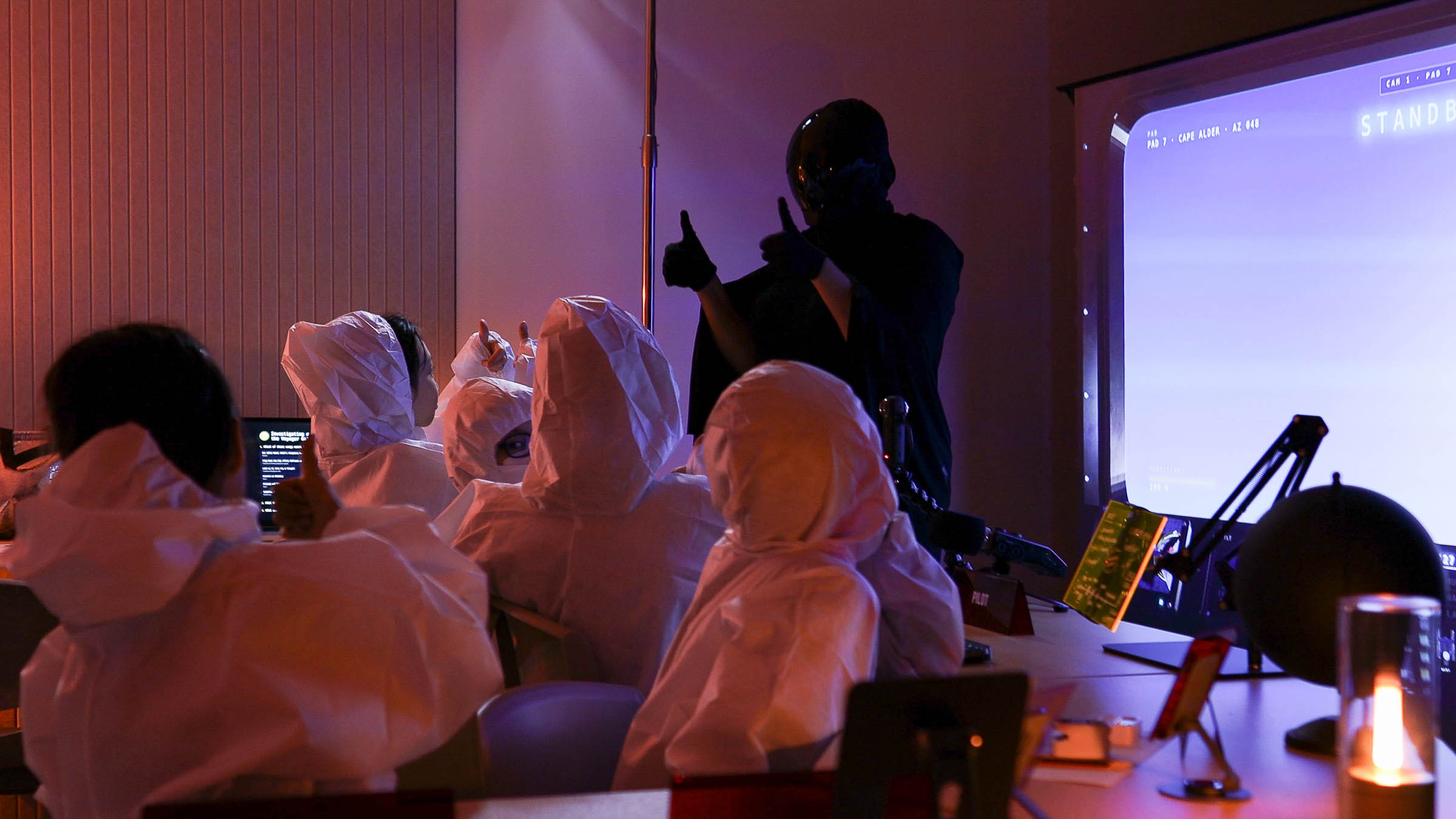
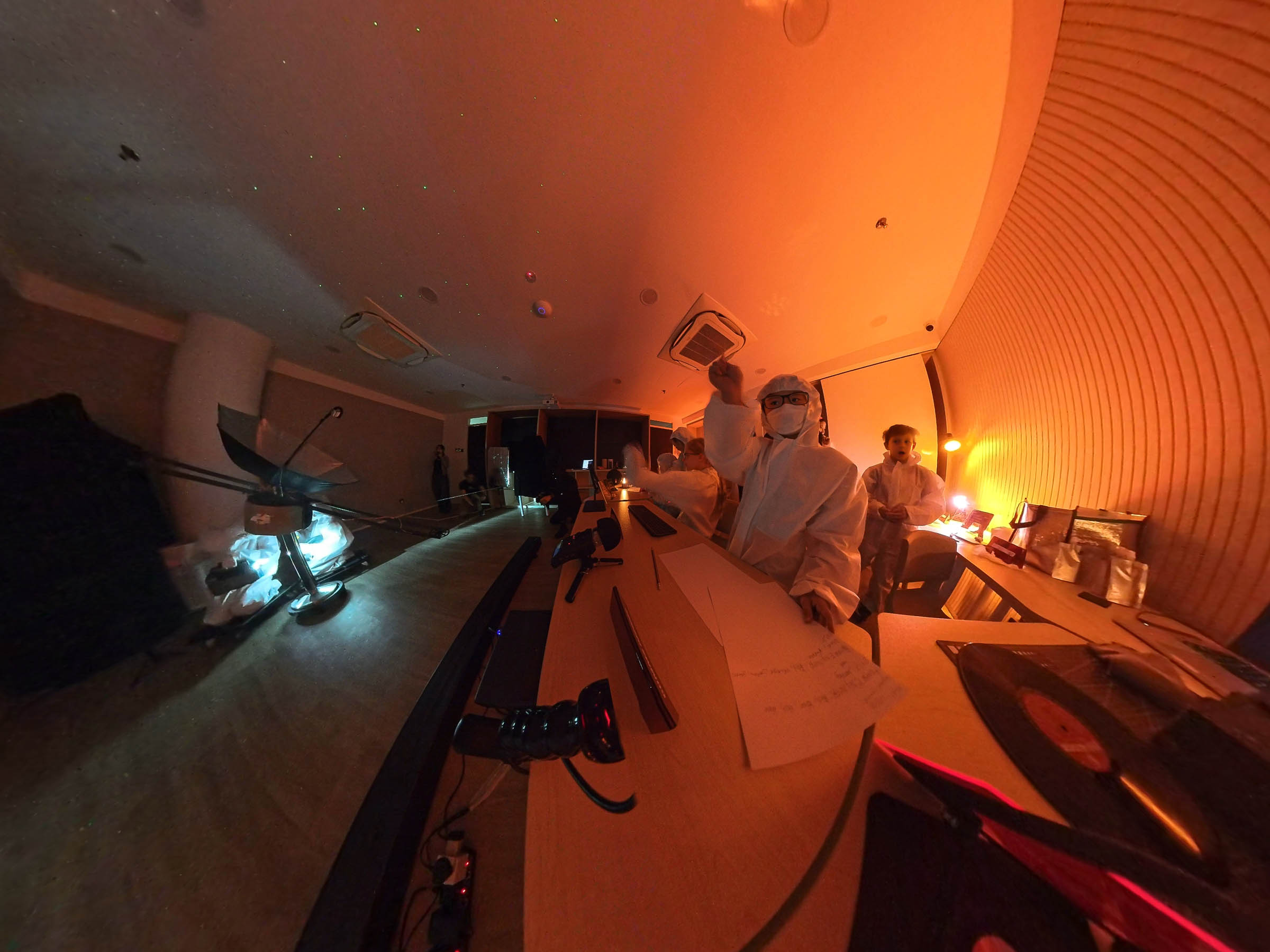
The room went orange. A model of Voyager waited ahead. Luxhini, a music-loving android, welcomed the crew aboard LightCraft 27, along with Lumi, her loyal and enlightened companion.
The brief was simple:
Reach the ageing Voyager probe. Retrieve the Golden Record. Find out if it still plays.
Nobody was told to pretend to be an astronaut. Each child became someone the mission needed: pilot, power engineer, quartermaster, payload specialist, communications officer, flight surgeon, or spacewalker. And every role came with real work.
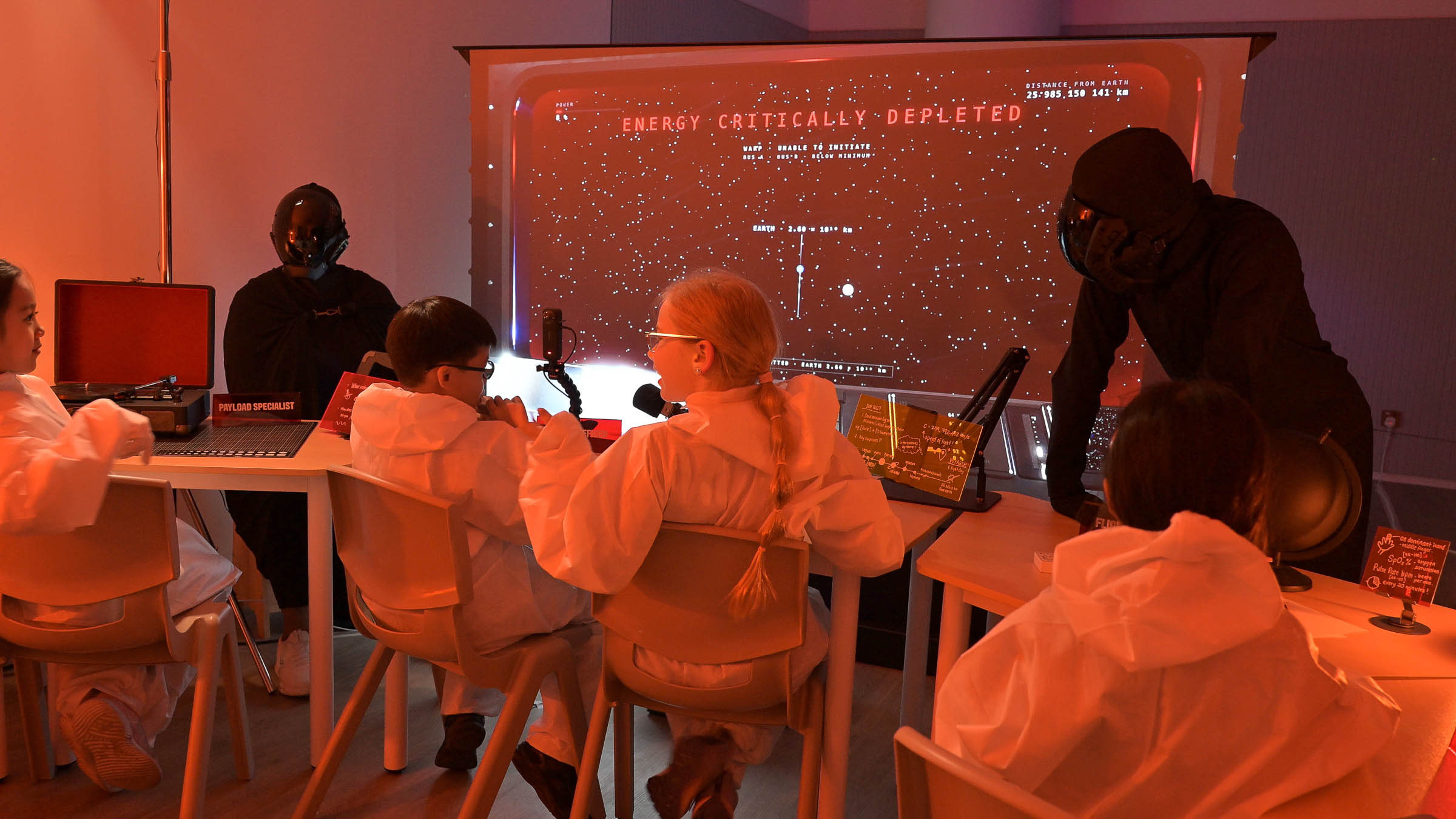
The pilot steered with the arrow keys, and could hand over the controls if they needed to. The flight surgeon checked everyone's blood oxygen and pulse with an oximeter every twenty minutes, and whenever anyone left or re-entered the ship, and could sit a crew member out if their readings fell outside the normal range. The quartermaster rationed energy. The power engineer held the relay codes. The communications officer filed a report on arrival: crew health, travel conditions, and mission status. And the payload specialist guarded the most fragile cargo on board: the Golden Record, and the record player to play it.
Then the mission started making demands
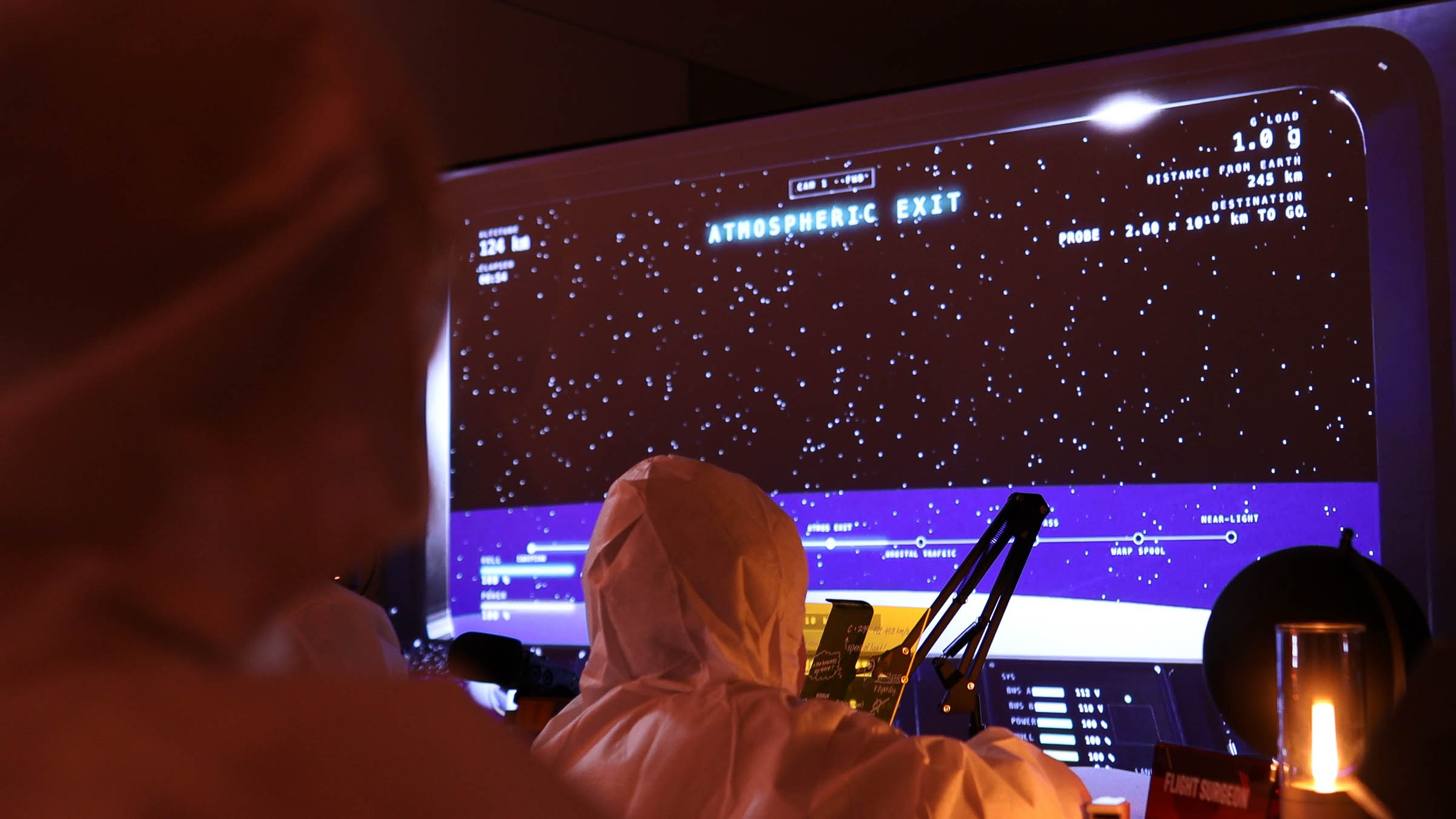
The ship cruised on autopilot until something appeared ahead: a car attached to a rocket, hurtling straight at them. Evasive manoeuvres! This was a nod to a real event. In 2018, a Tesla Roadster was launched into space, and it is still out there, orbiting the Sun.
Then the emergency power failed. To fix it, the crew had to rebuild a relay system from colour-coded tiles. Simple, except the room's orange light made every tile look the same dull shade. Only a single white lamp showed their true colours. Suddenly a broken relay was a lesson in light, wavelength, reflection, and absorption.
Then there was the space juice: a pouch of different flavoured drinks, standing in for the electrolytes a body needs to keep working. The crew had expected enough space juice for two astronauts to complete the spacewalk. They were wrong. And electrolytes stopped being a fact on a page. They were about the muscles, nerves, and bodies of the crew themselves.
The spacewalk
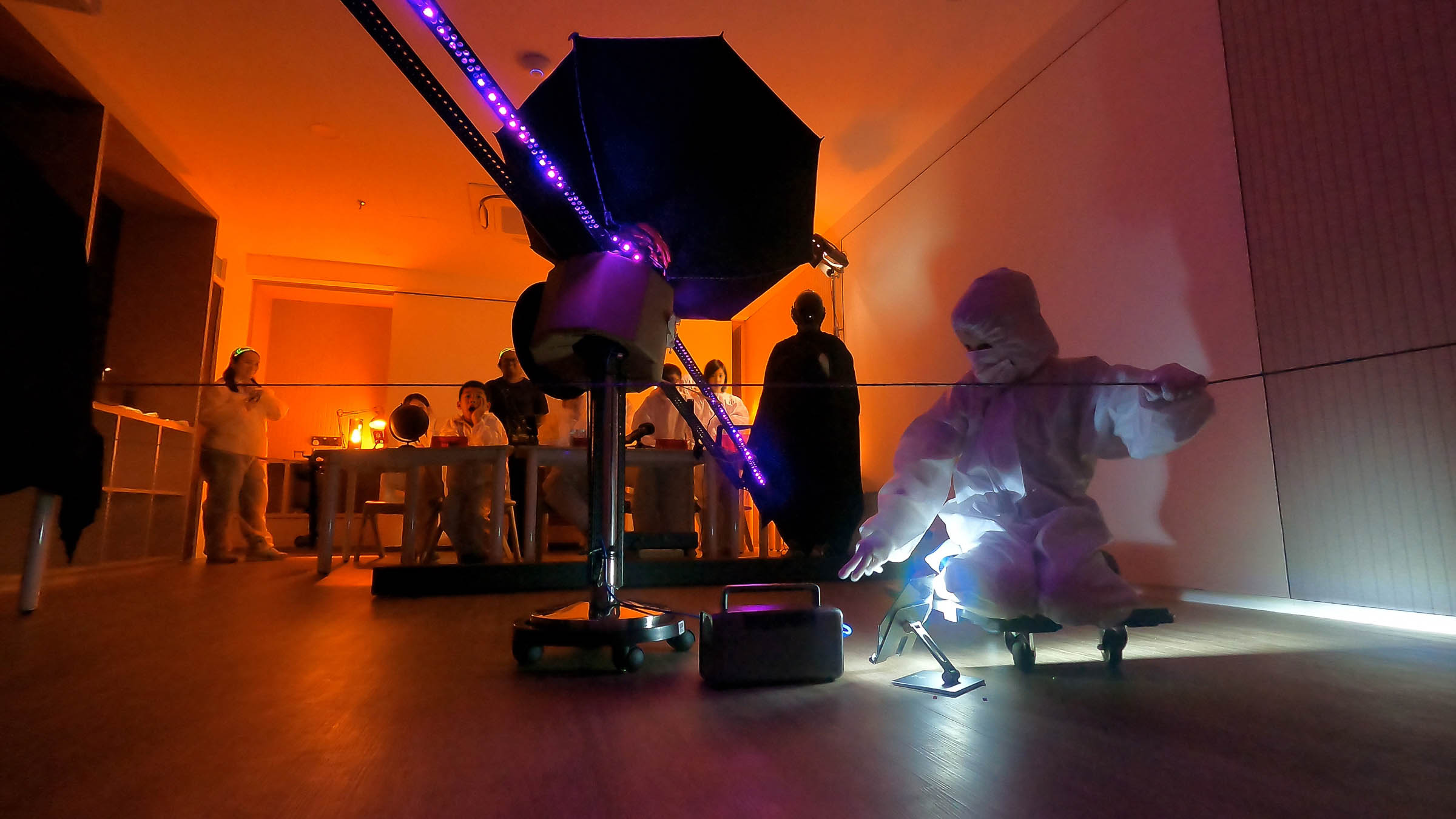
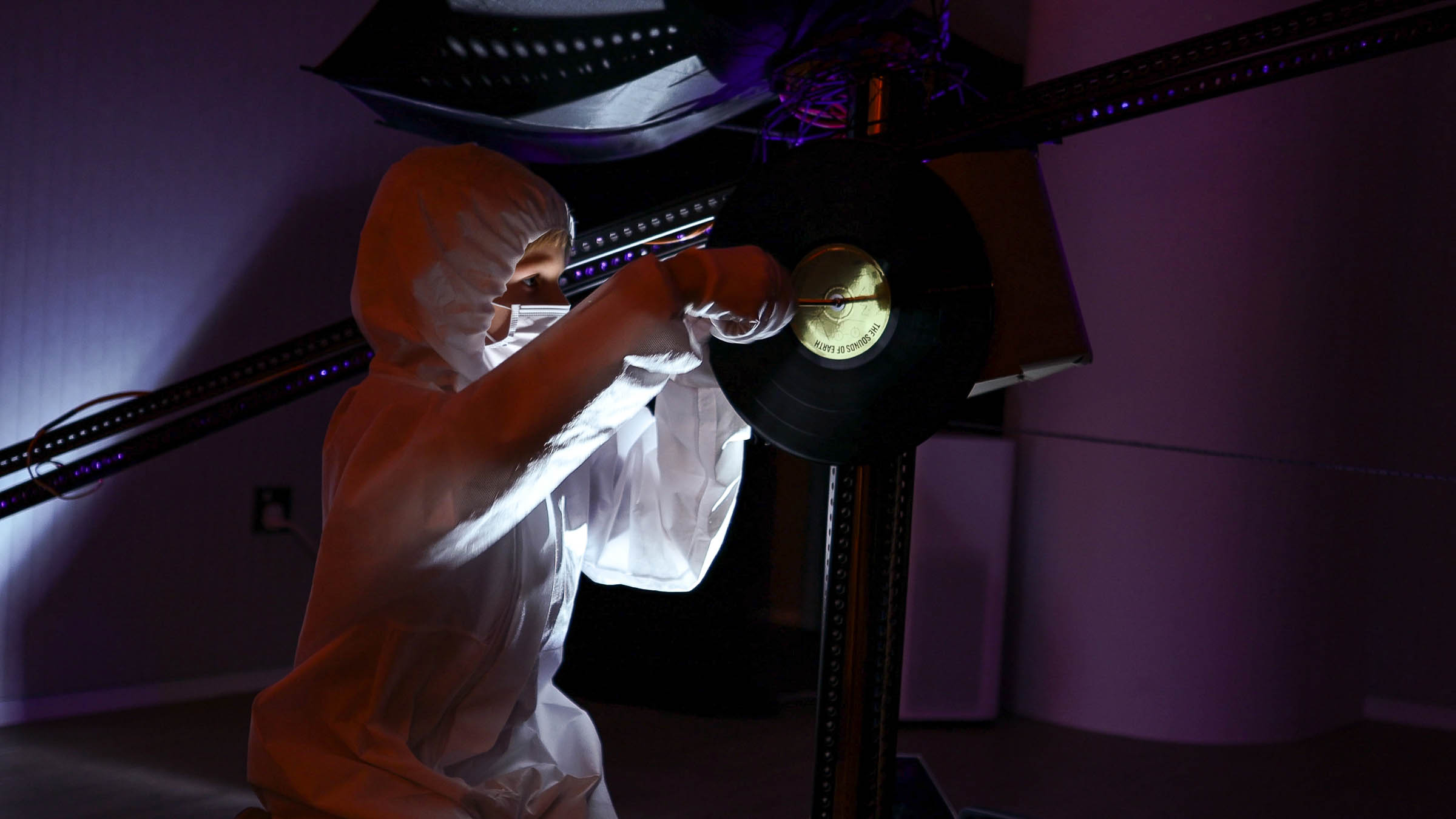
The spacewalk made weightlessness physical. Spacewalkers lay on small trolleys and moved along guy-wires, discovering how strange it is to move when there is nothing to push off. They recharged Voyager, positioned reflectors, reset the relay tiles, and, very carefully, removed the Golden Record.
The simulation wasn't perfect. Some earplugs were too big for small ears, so we adapted. But once the spacewalkers were out there, something clicked. They were in the zone. Afterwards, one child explained:
"If I get stuck in space, I should throw something, and I'll go the opposite direction."
That's Newton's Third Law. And suddenly it had a purpose.


And then there was Luxhini
Through all of this, Luxhini was becoming more than the android who had welcomed them aboard.
The children were curious about her from the start. She was a teacher they knew, transformed into something out of this world: a Kintsugi-style mask, restricted android movements, and a strange presence that made her part of this unfamiliar place. But she wasn't only there to explain the mission. She was there to listen.
When the payload specialist finally played the Golden Record, Luxhini listened too. The crew identified the piece: Beethoven's Fifth Symphony. Dum. Dum. Dum. Dummm. Human music, in deep space, moving an android to her core.
Mission complete, right?
Not quite. Playing the record had drained the power the crew needed to get home. There was no code to crack this time, and no right answer hidden in the room. There was only a choice:
What would you give up to bring someone home?
Luxhini made it for them. Moved by the human expression she had found on the Golden Record, she gave up her own power core so the crew could return safely to Earth with Lumi. We had begun with a question about what makes someone, or something, a person. In that moment, Luxhini became the question. The experience didn't hand the children an answer. It gave them a reason to keep asking.
Knowledge with somewhere to land
Look closely and there was science everywhere: light taking time to travel, propulsion and trajectory, colour and reflection, electrolytes, records and rotational speed, navigation and communication, the eight planets, and the thousands of satellites a spacecraft must navigate around before it reaches open space.
Some of it was explicit. Some hid in a prop, a question, a calculation, or a problem that needed solving. The point was never that every fact would be mastered in four periods. It was that the children met knowledge at the moment it belonged to something they were actually trying to do.
Every task had a real purpose, and every task was attemptable. The children didn't need to know everything before they began. They needed to observe, communicate, test, calculate, adapt, and try again. Even when part of the simulation misbehaved, we could adjust it without losing the idea underneath.
Complex ideas become accessible when children have a meaningful reason to use them, and memorable when they later recognise where that knowledge belongs in the real world.
Some facts they'll remember. Some they won't. But perhaps one day, when they meet Newton's laws, visible light, electrolytes, or the solar system again, they'll remember that orange room, the strange pull across space, the Golden Record, and Luxhini.
And with that, the sacrifice of Luxhini sent them home, with Lumi landing them and their learning safely… The day had seen compassion in the cosmos, and within the ethos of each child.
What is Fusion?
At Thesis, Fusion is where learning becomes an immersive play experience. Every month, we turn whatever a class is studying into a world they live in for two days. Children learning about space find themselves on a mission gone wrong, supplies running low, the clock ticking. What they learned last week is suddenly what they need right now, and every decision has consequences. We want them good at what they do, and good to the people they do it with, and the best lesson for that is practice. When the story ends, we step out of it together and talk about what happened, what it felt like, and what it taught us. That is the moment learning becomes real. What they study is more than what they are told. They know it now, for real.