The Human Bot-T
TL;DR
A robot kidnapped our principal, and the only way to get him back was to prove that squishy human bodies could do what a machine couldn't. Over two days, crews of 5- to 12-year-olds painted upside down, outran a cheetah, smashed food with giant teeth and rewired a broken brain to bring Mr Ian home. Along the way, they found out why Lord Bot-T took him. A robot who did everything alone could never do the one thing Mr Ian does best: bring people together.
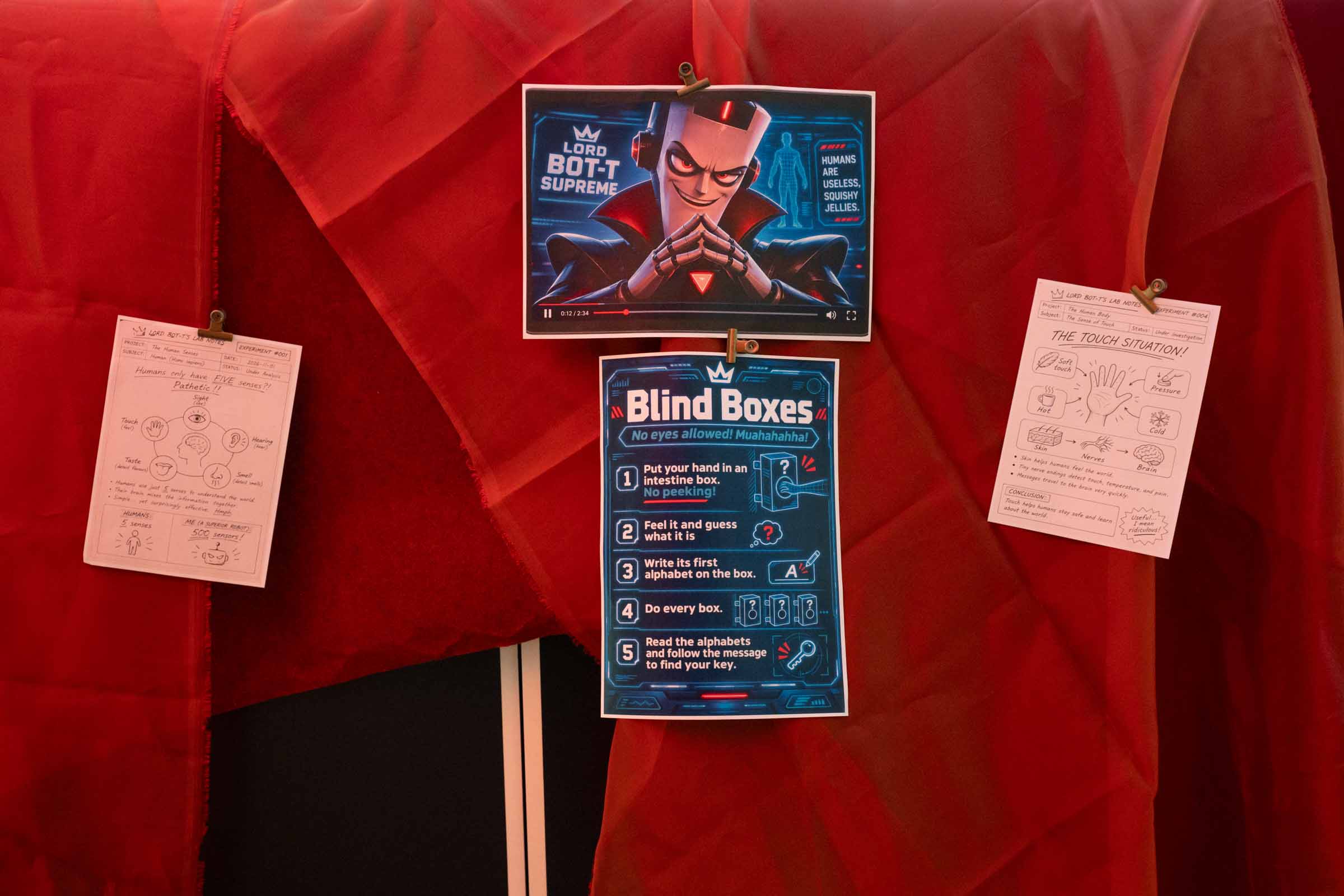
As we ventured into the human body through the veins of Fusion, we kept asking ourselves where the learning was happening. Which activities got children to use their heads, test their ideas and work together? Which had plenty of muscle but not enough substance?
So we tried a different question. What happens when you hand the human body to a room of children and tell them it's useless?
We had the senses, bones and muscles, digestion and the nervous system to explore. We could have handed out labelled diagrams. Instead, we gave the children someone who sneered at their bodies, and asked them to prove him wrong.
Meet Lord Bot-T Supreme
He was a self-absorbed, secretly envious robot, convinced of his absolute superiority over fragile biology. Every machine is built around a directive, and Bot-T's was two words long: DO BETTER. He took it to mean better than everyone else. He polished his titanium chassis, boasted about his super-processors, sneered at "squishy jelly humans" and worked alone, a mastermind who needed nobody.
Then he kidnapped Mr Ian.
He locked our principal in an iron-bound cage deep inside his simulation and broadcast the heist to every Thesian. Every transmission opened with an insult and an electronic cackle, and closed with the same command:
DO BETTER, HUMANS! MUAHAHAHAHAHA!
It landed harder than we'd hoped. Over break and lunch, the same questions kept coming back to teachers. "Will Bot-T kidnap Mr Ian again?" "Why did he turn Mr Ian into LEGO?" And, more than once:
"We need to destroy Bot-T."
Why a robot?
Because a robot gave the science somewhere to go. Every fact the children met was something they needed to beat Bot-T right now, not something to memorise for later.
And underneath the science sat the real question of the two days:
Is needing each other a weakness, or the very thing that makes us strong?
Here's the thing about Bot-T. His weakness was never his processor. It was that he did everything alone. That's why he took Mr Ian: the human best at bringing people together, the one thing Bot-T could never do.
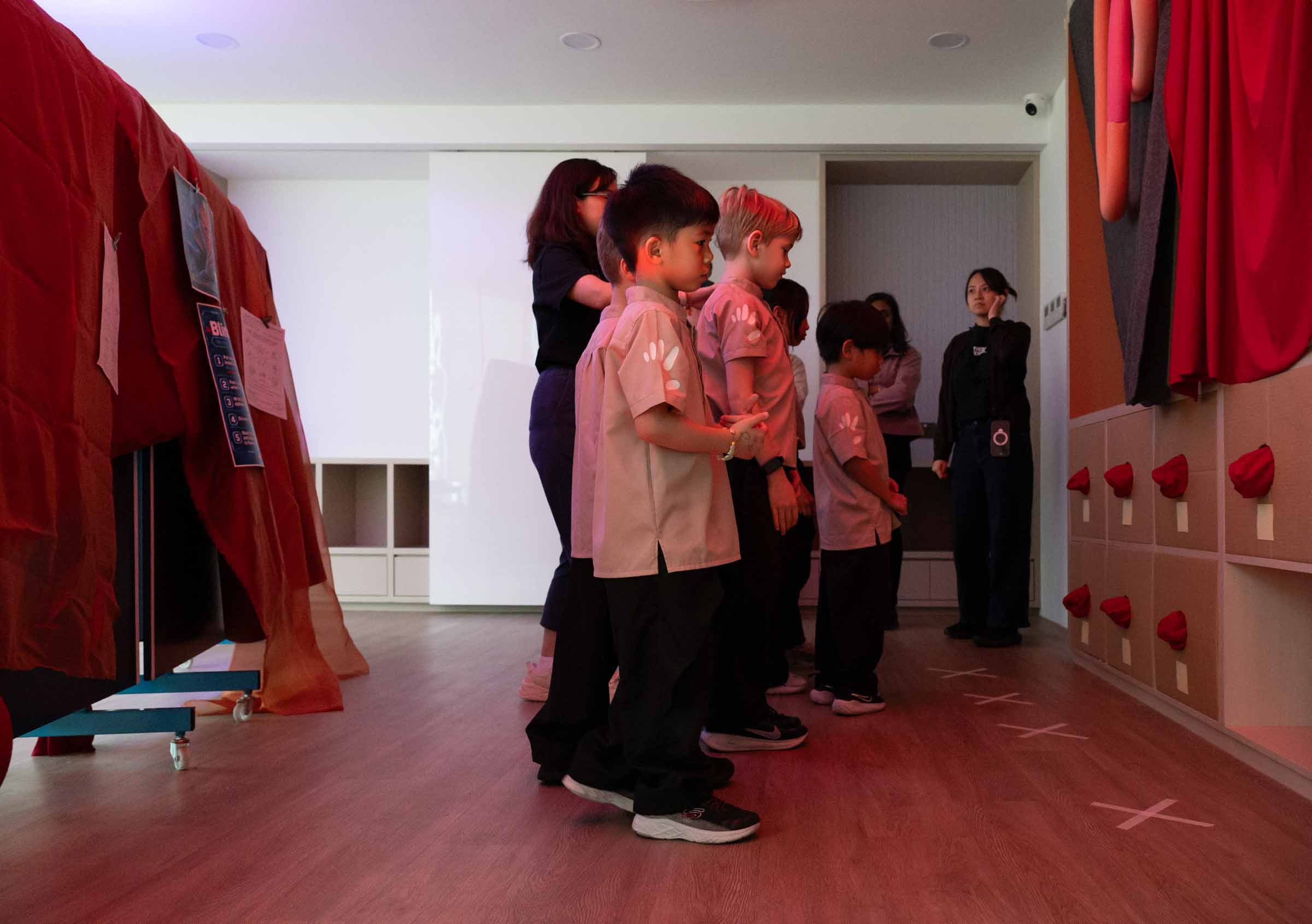
So we built every room so that nobody could solve it alone. Floor markings showed a spot for every child, so nothing could start until the whole crew was there. And every room proved the same point twice:
No part of the body works alone. Sight needs the brain. Taste needs smell. Muscles need bones. And to get Mr Ian back, the children needed each other.
Twelve stations became four
The first plans were wild. A blind tasting buffet spelling THINK. Bones etched with riddles to open a brass cryptex. A laser-style yarn web. Upside-Down Ross Bob, where children painted landscapes through inversion goggles. On Day 2, a stomach bag to knead until the word LIGHT surfaced, a cardboard breathing maze called the House of Haze, a Booger Digger full of cornstarch mucus, and a papier-mâché bolus squeezed through a six-metre nylon intestine into Bot-T's toilet.
Every station was undeniably fun. And that was precisely the trap.
Fun alone couldn't carry the day. So we kept asking: where is the friction? Which tasks make children observe, argue and rely on each other, and which are just a good show? Letting go of good ideas turned out to be far harder than having them. Twelve stations became four. Join-the-dots became a painting two children could only solve together. A pile of bones became a sorting challenge. The yarn maze became a glowing circuit board. Five disgusting digestion stations became one gloriously messy mouth and stomach.
Every change knocked into something else: the timing, the clues, the materials, the story. To keep ourselves honest, we gave our test a name:
Purpose > Process > Puzzle. A purpose worth pursuing, meaningful work to do, and a puzzle that makes you want to keep going.
Once those three lined up, the set came alive. Ching voiced and animated every one of Bot-T's broadcasts, and his sneers, panics and glitches set the pace for everything that followed.
Day 1: four keys, four padlocks
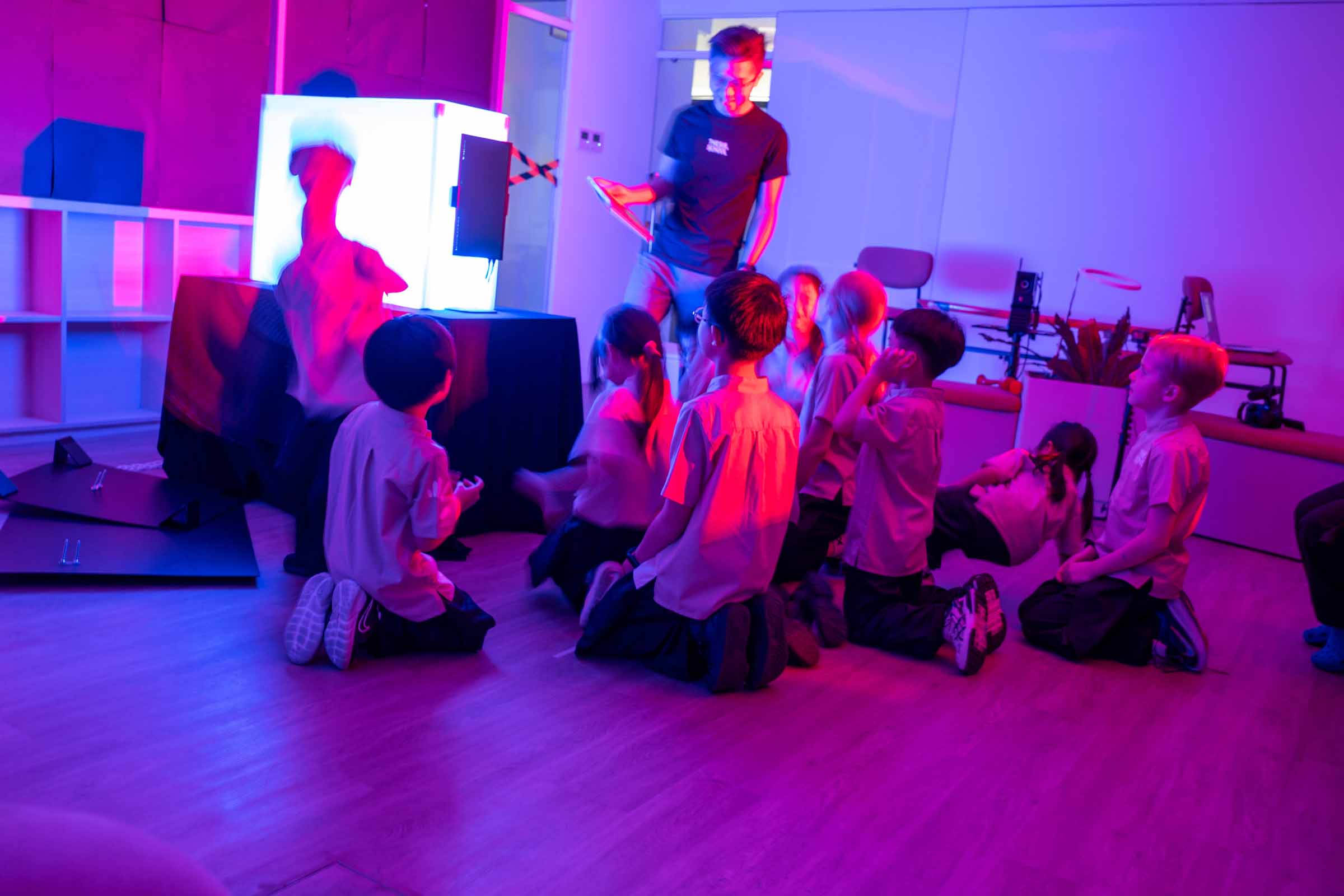
The children gathered around a black box wrapped in chains, four padlocks hanging from its front. Through a little window, a screen showed Mr Ian in his cell. A sigh. A groan. A tug of his greying hair. Then a dash to the glass:
"Thesians! Get me out!"
The children split into two crews. Every challenge won a key, and every key meant a sprint back to the cell to open a padlock. The rescue was on.
"Your eyes see the world upside down"
Bot-T's first diss was about eyes. Humans need them for everything, he said, and they even see the world upside down, so the brain has to flip it like a pancake. Pathetic.
The strange part? He's right. The lens at the front of your eye flips the picture onto the back of it, and your brain turns it the right way up without you ever noticing.
So the first crew had to do the flipping themselves. Each pair sat in front of an upside-down canvas. Each child looked down their own viewing tube at a sample painting the right way up, and held a single colour, blue or yellow. Block by block, they had to work out where everything went. Where the two colours overlapped, green appeared, and the green hid the code.
It was disorientating at first. Some children quickly spotted that they didn't need to recreate the whole picture, only the part where the two paintings overlapped. Others needed a nudge. The youngest handled the upside-down view surprisingly well. Sometimes the breakthrough comes not from doing more, but from seeing exactly what needs doing.
Then Bot-T took their eyes away completely. Blindfolded, the crew reached through the fabric covers of a row of boxes, lined up like a Wheel of Fortune board, and named each object by touch, smell or taste, and the letter it began with.
Their first question was whether there were any animals inside. The diaper held them up for quite some time. An iron was easy to recognise but hard to turn into a word. And when BIG came out as BCG, their guesses went off in entirely the wrong direction. Slowly, the letters spelt it out:
UNDER THE TABLE.
All eight children looked under the table. None of them spotted the key. One child found it by accident. Another insisted they go back and work the clue out properly.
Seeing and understanding are not the same thing. Your eyes take in the world, but your brain makes sense of it. And when one sense is taken away, the others step in.
"Humans are just a pile of bones"
The second crew got a different insult. Humans were just a pile of bones, Bot-T scoffed, and they couldn't keep up with a machine, or even a cheetah.
One at a time, the children ran on the spot in front of a webcam, racing Bot-T's cheetah across the wall. At thirty seconds, the screen exploded with confetti: CHEETAH WINS! Bot-T counted down, the END button glowed, and the children pressed it, exactly as instructed. And lost. Again. And again.
Then Mr Ian hacked into the feed:
"Thesians, don't listen to him! The race isn't over until YOU stop running!"
The next runner simply kept going. The cheetah overheated, flopped down panting, and the child overtook it.
That's real biology. Cheetahs are the fastest sprinters on Earth, but they can only hold top speed for around half a minute before they have to stop. Humans are slower, but we sweat to stay cool, so we can keep going long after a cheetah has to stop.
Then a child asked a question nobody had planned for:
"What if we all run together? Would it make us faster?"
Suddenly the whole room was running, children and adults alike. They weren't just racing a cheetah any more. They were questioning the rules of the game. Bot-T's instructions, it turned out, weren't there to help them win, and that was a useful thing to carry into Day 2.
The crew still had the bones to deal with. Two hundred and six of them, Bot-T sneered, and humans couldn't even put them back together. (He only knew the grown-up number. Babies are born with around 300 bones, and many fuse together as we grow.)
From a pile of human bones, bone-shaped dog treats, plastic bones, foil, magnetic tiles and scraps, the children had to pick out the human ones and build a skeleton over an outline. They spent several minutes debating whether a dog chew toy was actually a human pelvis. They also attached the feet where the hands should have gone. The job wasn't to collect pieces. It was to work out which belonged to a human, and where each one went.
A riddle in the jaw led them to a secret message in UV ink: THINK. And another key.
The cheat
Back at the cell, the last padlock clicked open and the chains fell away. Inside the big box was a smaller one, like a Russian nesting doll, and on its little screen was Mr Ian, relieved.
They had done it! For about three seconds.
Then he flickered. A vortex opened, and Bot-T sucked a pixelated Mr Ian into his titanium body. "You're never getting him back! He's the LAST piece I need!" As he disappeared, Mr Ian shouted one last instruction:
"SAVE MEEE!"
The screen went black, and the room filled with children demanding justice. The last piece of what? Nobody knew. Yet.



Day 2: Project Human Upgrade
The next day, Bot-T's screen glitched: INTRUDER ALERT. And there, hidden in plain sight, was the secret he had been keeping:
PROJECT HUMAN UPGRADE: 97% COMPLETE
The blueprint showed a human body wearing Bot-T's face. All that time spent mocking squishy humans, he had secretly been building himself a nose, ears, nerves, even a tummy. He had copied every part. He just had no idea how to look after them. He never rested, never drank water, and his head had been pounding for weeks.
Now he was panicking, and every instruction came out as a DON'T. "DON'T touch that!" "DON'T look in that box!" The children cracked it fast: wherever Bot-T said DON'T, that was exactly where they needed to go.
Digestion through destruction
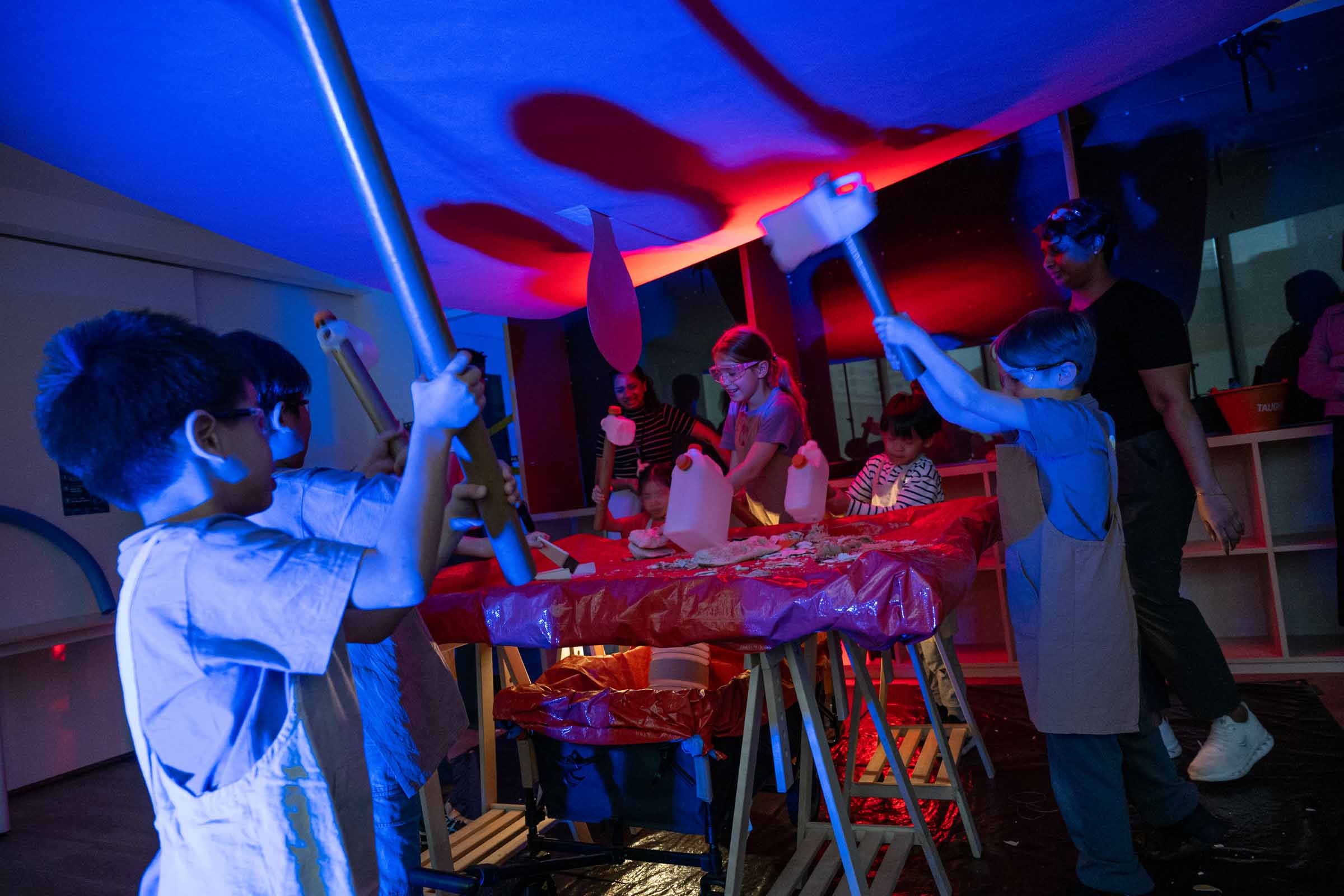
One crew went into Bot-T's mouth: a plastic-covered table with a uvula dangling overhead. They wore aprons and safety glasses, and they needed both.
The food was giant clay parcels, far too big for the food pipe. So the children hunted down hammer-axes shaped like teeth: incisors for cutting, canines for tearing, molars for grinding. That's the same job your own teeth do every lunchtime. They smashed until goo squished out and the pieces were small enough to push down the chute, then broke through the pretend food pipe underneath to find Bot-T's stomach: a fizzing, bubbling tub of gunk.
"DON'T put your hands in my STOMACH!"
Naturally, they did. Buried at the bottom were two blocks of Pixel Mr Ian, coated in machine bile.
It was the loudest room by far: little talking, lots of shouting, chopping and smashing. Teachers dodged giant molar hammer-axes swung by very small people. One child who loved slime couldn't bear to touch the stomach gunk. In the end, she was the one who ran out with the Pixel Mr Ian pieces swaddled in a towel.
Synapse search
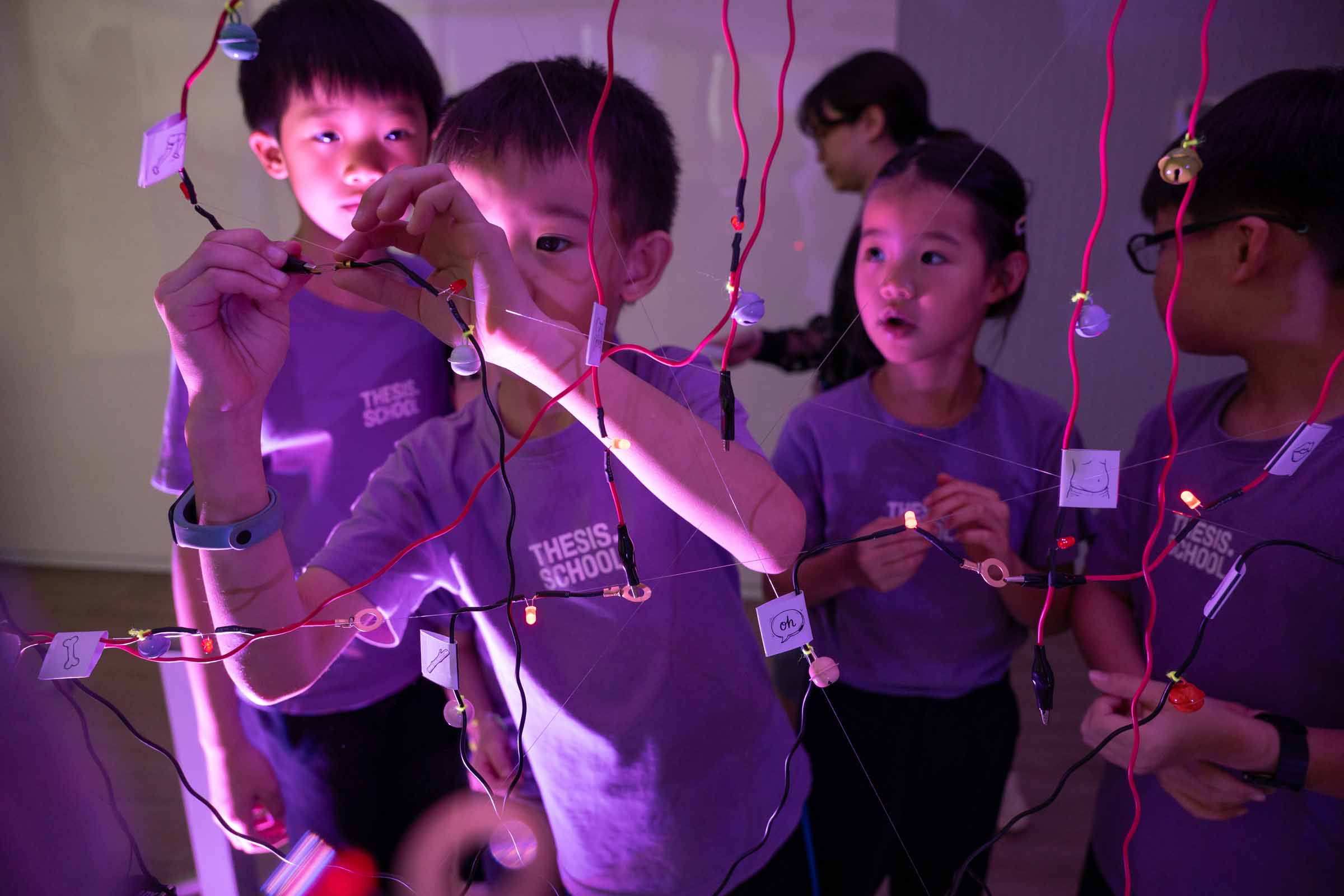
The other crew went into Bot-T's brain, where his neurons had come apart. A table of wires, alligator clips and bulbs held the pieces of his broken network. Each wire carried a picture, and the children had to work out which pictures belonged together, then clip them into place.
Some pairs were easy: a belly and a button, a knee and a cap. Others took real thought. A hip and a shout of "Oh!" made a hippo. A thigh and a "GRRR" made a tiger.
Each child had a minute to try. At first, nobody got one right. They kept going anyway, cheering each other on, and the moment the first connection lit up, they were ecstatic. After that, they cracked each of the rest in no time.
Each bulb stood for something real: a synapse, the tiny gap where a message jumps from one neuron to the next. Every thought you have travels that way. When every connection was right, the whole network lit up, and out came the last two blocks.
Do better… together
Both crews came together, rebuilt Pixel Mr Ian and slotted him into a port labelled USB PORT. DO NOT LIFT (USE SOMEBODY BETTER).
The screen went black. "Mr Ian? Are you there?" Nothing. "MR IAN!"
Then a voice boomed from UNDER THE TABLE:
"I'M BACK, KIDS! Pull me out!"
The real, human Mr Ian was hauled out by wildly relieved Thesians, and the noise could have torn down walls.
Then one last message played. On screen, Bot-T looked more human than he ever had, and finally admitted why he'd done it:
"You're the best at bringing people together. I thought if I took you, I could have that too… I guess I was just lonely."
Then, almost hesitantly: "Thesians, would you have a grumpy robot like me join your team?"
Mr Ian said yes. Bot-T could hardly believe it. He changed his primary settings from DO BETTER to DO BETTER TOGETHER. Then he demanded his own room and his own coffee machine.
Some things don't change.
Holding the world together
None of the story on screen was improvised. Every broadcast, every hack into the feed, the cheetah race, the INTRUDER ALERT and the final video were scripted, edited and timed to the second, with audio cued live. That taught us the loudest production lesson of the term. Music, video, speakers, projectors and lighting aren't finishing touches. They're part of the machinery. When they work, they hold the world together. When they don't, the seams show. Next time, they get built and tested much earlier. So does the clay: too thin and it broke too soon, too thick and nobody could crack it.
Day 2 ran more smoothly. Bringing children into the story one at a time worked better than as a group, and the crews were well matched. This time we kept Mr Ian visible, and after the children stepped out of their roles, we brought the story to its conclusion and talked it through. A final video with a well-timed beat drop gave them a proper ending, and new journals, with five questions and story-themed colouring, gave them a way to relive it.
And some of the best moments needed no script at all. Two of the youngest boys teamed up while smashing the food, shouting "Better together!" as they went. Another child confronted Mr Ian about the injustice of being turned into LEGO. Nobody planned those. They gave the experience a life of its own.
What stayed with us
The victory was loud, messy and thoroughly deserved. But the real achievement wasn't four keys, four padlocks, or even bringing Mr Ian home.
It was watching children use what they knew, work out what they didn't, and discover that a problem can be solved in more than one way. They met the body not as a diagram to label, but as a living system of connected parts: eyes that take in light, a brain that makes sense of the senses, bones that hold us up, muscles and sweat that keep us going, teeth that break food down, a stomach that digests it, and neurons that carry messages across synapses.
Some of it was explicit. Some of it hid inside a paintbrush, a blind box, or a rule with a loophole. The point was never that every fact would be mastered in two days. It was that each idea arrived at the moment the children needed it.
They didn't always get there straight away. Sometimes they guessed. Sometimes they missed what was right in front of them. But they also questioned instructions, spotted patterns and found answers we hadn't anticipated. The older children coached without taking the brush. The younger ones painted layers nobody else could. And the crew that kept pressing END learned that the rules aren't always the whole story, and that sometimes the bravest thing is to keep running.
Bot-T set out to prove that humans were inferior because they were squishy, dependent and imperfect. The children proved that those very qualities are part of their strength.
Bot-T thought DO BETTER meant better than everyone. The children showed him what it actually means: better with everyone.
Do better, humans. Together.

What is Fusion?
At Thesis, Fusion is where learning becomes an immersive play experience. Every month, we turn whatever a class is studying into a world they live in for two days. Children learning about space find themselves on a mission gone wrong, supplies running low, the clock ticking. What they learned last week is suddenly what they need right now, and every decision has consequences. We want them good at what they do, and good to the people they do it with, and the best lesson for that is practice. When the story ends, we step out of it together and talk about what happened, what it felt like, and what it taught us. That is the moment learning becomes real. What they study is more than what they are told. They know it now, for real.